

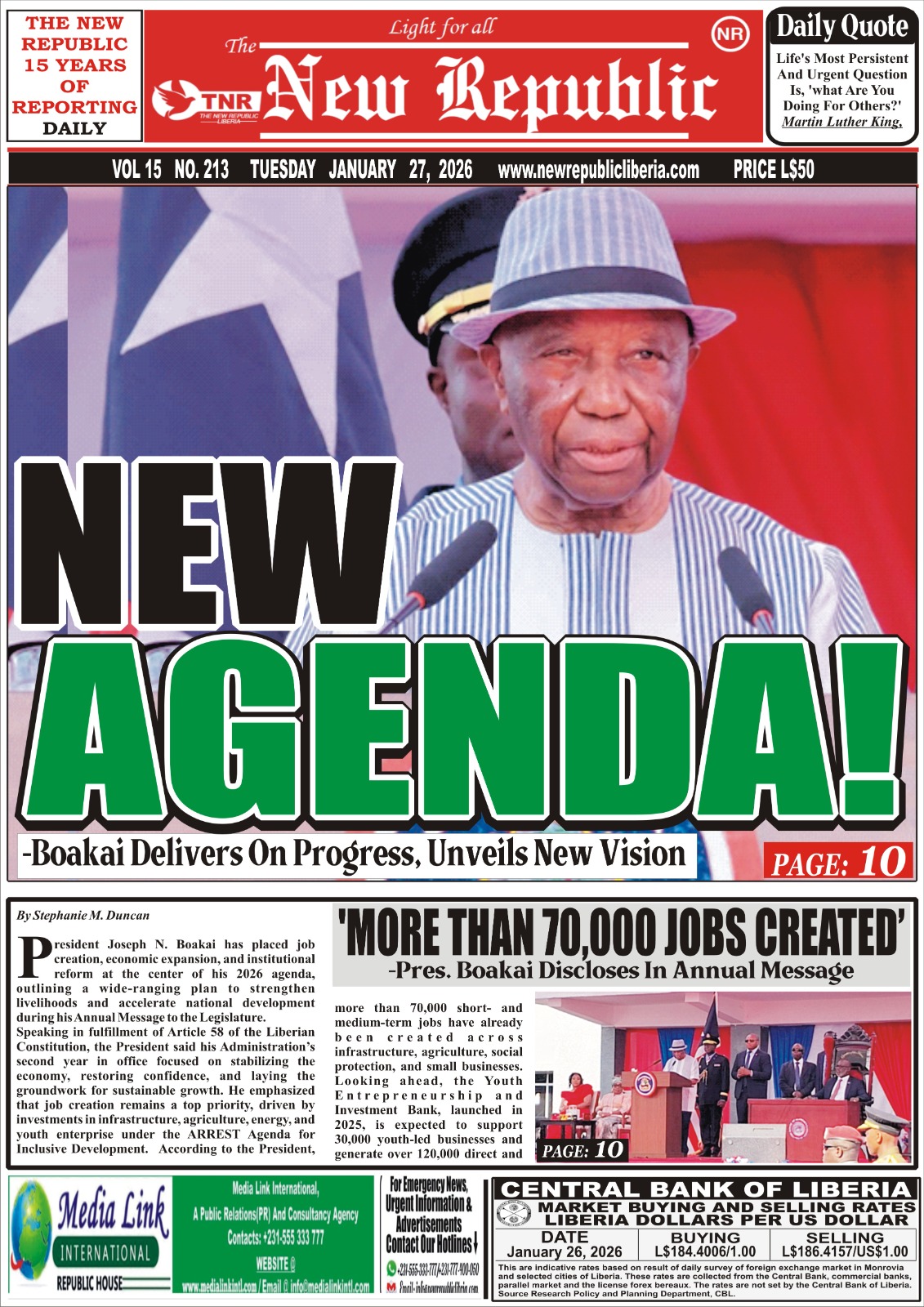
MONROVIA-President Joseph Boakai’s third Annual Message to the National Legislature was not short of reflections on the progress made and challenges endured during the year under review as well as bold new agenda and vision aimed at reshaping progressive national development agenda.
In his nearly one and half hours address Monday, President Boakai made known where and how he intends to tackle the country’s problems, in keeping with the government’s development encapsulated in the ARREST Agenda for Inclusive Development (AAID).
New Agenda
Reporting to the Legislature in consonance with Article 58 of the Liberian Constitution, the Liberian leader said his government will endeavor to improve on the progress made over the last two years with new set of new development programs.
“Beyond the progress we celebrate today, unresolved matters continue to weigh on our national conscience, affect our dignity, and demand decisive action,” President Boakai declared, and pledged to take the following steps without delay.”
As part of his vision moving forward, President declared that he will ensure that “we continue to comprehensively review our concession framework to correct historical inequities in the extraction and management of our natural wealth and to ensure that Liberia and its people receive fair and lasting benefits.”
Also, he disclosed that he will take immediate action to resolve the long-standing issue of relocating the Palm Grove Cemetery, where the remains of former Presidents and other distinguished citizens lie.
“This is a matter of national honor, historical responsibility, and respect for those who served our Republic,” the President said.
At the same time, President Boakai reported to the nation that he will act to rehabilitate decaying public buildings in Monrovia and across the country, with the home of restoring dignity to public service and safeguarding national assets for future generations.
“Fourth, I will initiate the process of laying out major cities throughout Liberia, consistent with recent decentralization initiatives and the newly enacted zoning law of Liberia,” he committed.
Renewed Commitments/legislative agenda
According to the President, his administration will continue implementing the ARREST Agenda to improve livelihoods, strengthen democratic governance, and enhance Liberia’s standing in the world.
Counting on the cooperation and collaboration with the national legislature, he said his government aims to strengthen institutions, grow the economy, and improve the well-being of all Liberians.
As it relates to his new agenda, he said: “In 2026, we will submit additional priority bills, including legislation to establish a National Planning Commission to strengthen development planning and budgeting.”
The Liberian leader also vowed that he would establish a specialized court for property disputes to reduce the backlog of land cases, adding “We will propose a universal health insurance program and a bill to establish a National Road Authority dedicated to road construction and maintenance.
Still advancing his new agenda for 2026, President said the administration will resubmit the revised Charter of the University of Liberia to accommodate needed reforms and administrative structures
Among other things, he pledged expanding the of Liberia Agriculture Commodities Regulatory Authority’s mandate to enhance the output, processing, and marketing of quality agricultural commodities, while emphasizing that “We will also seek an amendment to the Executive Law to restructure the Ministry of Foreign Affairs so it can better serve citizens and adapt to our evolving international responsibilities.”
As part of his new agenda, the President told legislators about his intention to submit bills to repeal outdated People’s Redemption Council-era decrees that created public institutions that no longer serve today’s governance needs.
State of the Economy & 2026 Economic Outlook
Liberia’s economic architecture constituted good percentage of the President’s Annual Message, telling lawmakers and Liberians in general that the economic challenges inherited by his Administration could not be an excuse, but to highlight the hurdles it faces and the progress it has achieved.
He disclosed that “Through disciplined fiscal management, sound policies, and robust partnerships, we began restoring stability and trust.”
President Boakai added that as of 2024, the economy showed resilience, with steady growth, declining inflation, stronger reserves, and renewed momentum across key sectors. This progress continued into 2025, with macroeconomic stability and private-sector growth strengthening our commitments to the Liberian people.
The Liberian leader announced that the economy grew by 5.1 percent in 2025, exceeding both the 4.6 percent forecast and the 4.0 percent growth recorded in 2024. He added that “The achievement was driven by significant gains in mining, agriculture, fisheries, and services. Mining expanded by 17 percent, and exports rose by 31.5 percent.”
He said ongoing reforms ongoing reforms and infrastructure investments are expected to boost growth to over 5 percent in 2026, with average growth projected at about 6 percent from 2026 to 2028, saying that “Inflation fell to 4 percent by December 2025 – the lowest in over two decades, down from 10 percent when we took over in 2024.”
“These achievements signaled effective monetary and fiscal policies, coupled with anticipated easing of import costs,” he bragged.
“Liberia’s external sector performed well in 2025. Gross international reserves increased from $475 million in 2024 to $576 million, surpassing the previous year by US$101 million. Also, net international reserves exceeded IMF targets, potentially reaching $280 million by December 2025, and exports grew over 31 percent to about,” the Liberian leader went declaring.
Also, he announced that the government’s medium-term strategic gold initiative, or gold purchase program, is expected to further strengthen reserves and enhance economic resilience.
President Boakai disclosed that Liberia met “nearly all IMF Performance Criteria in June 2025, reaffirming our commitment,” stressing that the IMF External Credit Facility remains crucial for rebuilding reserves to cover 3.3 months of imports by 2027, supported by prudent fiscal measures.
He said further that foreign investments in iron ore mining will also boost exports and the current account. Since September 2025, the foreign exchange market has been stable due to good liquidity management, fiscal discipline, and strong export earnings.
“The Liberian dollar appreciated by at least 3 percent against the US dollar. We are committed to maintaining currency confidence and stability,” he asserted, underscoring that they accelerated Liberia’s digital finance revolution— processing over 275,000 transactions valued at more than 375 million Liberian Dollar and US$2.7 million by December 2025. Our goal is to raise financial inclusion from 52 percent in 2024 to over 70 percent by 2029.
President Boakai also reported that the Central Bank is rebuilding public trust by strengthening governance and accountability and managing government securities more openly. “In 2025, it issued US$44.4 million, rolling over US$132.1 million, and 7.6 billion Liberian Dollars,” he said, adding “And for the first time in decades, the Bank recorded consecutive operational surpluses in 2024 and 2025.”
He also praised good economic relations with bilateral and multilateral partners, reporting that government’s development program faced one of its toughest tests.
The President indicated “An abrupt slash in donor support during the second quarter disrupted financing for essential social and economic projects. This, he said, led to job losses, reduced incomes, and hardship for many families, noting that the government stepped in to close funding gaps and keep critical services running, but the disruption slowed implementation and strained our plans.
“Notwithstanding these challenges, we are pleased to report that we weathered the storm by instituting a package of measures that included tighter fiscal controls, while protecting critical social expenditure in health and education, and significantly enhancing domestic resource mobilization efforts,” President Boakai said.
According to him, the Government concluded nine financing agreements totaling US$334.98 million, including US$98.58 million in concessional loans and US$236.4 million in grants, to advance national priorities, and added that the agreements supported investments in infrastructure, human capital development, and natural resource management.
President Boakai also weighed in on the progress accrued from engagement with the United States which he said positioned Liberia for a Millennium Challenge Corporation Compact.
“I am pleased to report that after a review and reassessment by the new US Government, Liberia’s eligibility for a second MCC Compact was reaffirmed in December 2025. The compact development process has begun, focusing on investments in energy and job creation,” the Liberian announced.
President Boakai thanked bilateral and multilateral partners—including the United States of America, European Union, the People’s Republic of China, the, the United Kingdom, Japan, Qatar, United Arab Emirates, Kuwait, Morocco, the International Monetary Fund, the World Bank, the African Development Bank, the United Nations and its agencies, the African Union and the Economic Community of West African States, and the Mano River Union—for their trust, support, and ongoing commitment to Liberia as we strive to restore stability and bring essential relief and opportunities to our people.
Wooing officials
President also used his Annual Message to woo officials of government, reminding them, once more, of service to country and people, not necessary about personal gains.
“We are here to serve the Liberian people, not ourselves. If our purpose strays from service, disappointment will follow, and the truth will be unavoidable that we belong elsewhere. Service is the measure of leadership,” the 80-Yr-Old leader warned.
He said Liberia now stands at a defining moment between our past and our future, adding “the choices we make now will determine whether we advance or fall behind, whether we honor or betray the hopes entrusted to us.”
“Let us govern, legislate, and judge in the supreme interest of the Liberian people, knowing that history will render its verdict on whether we rose to this moment and changed the course of our nation for the better,” President Boakai pleaded.

Alphonso Toweh
Has been in the profession for over twenty years. He has worked for many international media outlets including: West Africa Magazine, Africa Week Magazine, African Observer and did occasional reporting for CNN, BBC World Service, Sunday Times, NPR, Radio Deutchewells, Radio Netherlands. He is the current correspondent for Reuters
He holds first MA with honors in International Relations and a candidate for second master in International Peace studies and Conflict Resolution from the University of Liberia.
Comments are closed.