

|
Getting your Trinity Audio player ready...
|
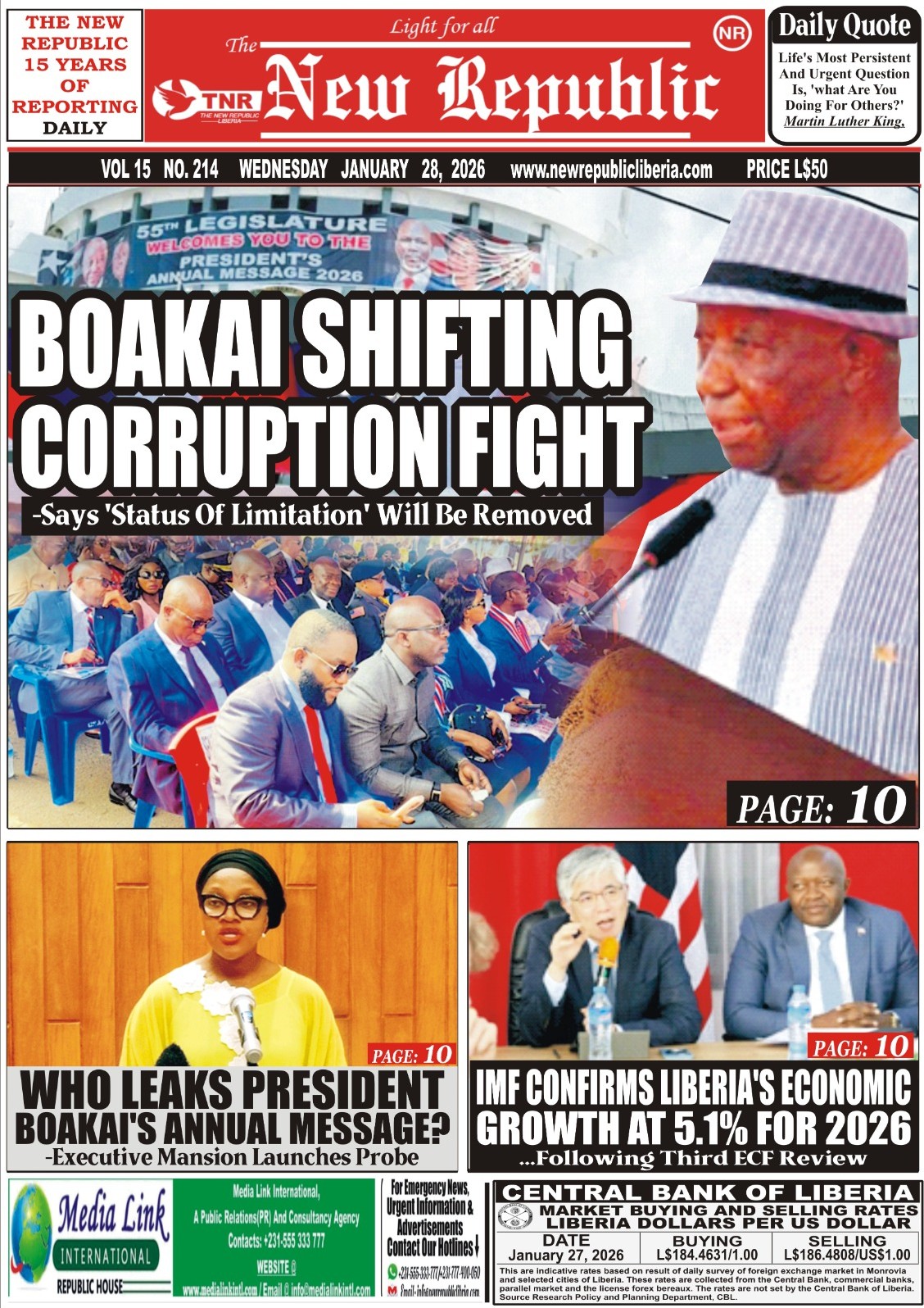
MONROVIA–President Joseph Nyuma Boakai appears to be shifting the gear in his government’s fight against corruption to ensure that every impediment is gotten rid of.
Delivering his 3rd Annual Message to the nation Monday, President Boakai called for amendments to existing anti-corruption laws, including the removal of the statute of limitations on corruption case.
In Liberia, the statute of limitations for prosecuting most corruption and economic crime cases is generally five years, after which perpetrators may not be held liable without an earlier indictment. However, the Liberia Anti-Corruption Commission and government are actively seeking to amend this law to remove such limitations.
The law currently prevents the prosecution of corruption-related crimes, such as embezzlement and misappropriation, if not pursued within a specific period, often cited as five years for economic crimes.
There are active legislative efforts to amend Chapter 15 of the Penal Code to remove the statute of limitations for corruption and financial crimes, allowing prosecution regardless of when the crime occurred.
In recent years, the Liberia Anti-Corruption Commission (LACC) has consistently argued that the existing statute of limitations hinders the prosecution of long-standing corruption cases and weakens the fight against impunity.
The Liberian leader declared that the country is “in a better state than it was a year ago,” highlighting progress in agriculture, infrastructure, education, health, tourism, and the rule of law.
Despite acknowledging inherited economic challenges, President Boakai emphasized his administration’s commitment to improving livelihoods, strengthening democratic governance, and enhancing Liberia’s global standing.
President Boakai lauded the Legislature for passing key bills, including the Ministry of Local Government Act, the Liberia National Tourism Act, and an Act to establish the National Food Assistance Agency.
He urged the Legislature to prioritize pending legislation, including the Presidential Transaction Act to streamline government transitions, bills to establish a Civil Service Commission, and amendments to the Mineral Development Agreement with Aslam Itzhar Holdings.
He also called for amendments to existing anti-corruption laws, including the removal of the statute of limitations on corruption cases.
President Boakai outlined plans to submit additional priority bills in 2026, including legislation to establish a national planning commission, a specialized code for property disputes, a universal health insurance program, and a national road authority.
He also mentioned plans to revise the charter of the University of Liberia and restructure the Ministry of Foreign Affairs.
Beyond legislation, Boakai highlighted 16 executive orders issued to advance governance and economic and social priorities. He reiterated his administration’s commitment to cooperation among all branches of government.
At the same time, the Liberian leader did not hide his thoughts about the fire incident on the Capitol Building that left the entire Joint Chambers destroyed, vowing tougher action against anyone found guilty will bear the full weight of the law.
In December 2024, a fire engulfed the Capitol Building which was attributed to a deliberate arson attack set, according to a report from Fire Rescue Alliance (FRA) investigators. The comprehensive investigation, which concluded on March 4, 2025, determined that the blaze was incendiary in nature, ruling out accidental causes.
Days following the tragic fire incident at the Capitol Building, the Liberia National Police (LNP) and Liberia National Fire Service (LNFS) confirmed that the December 18, 2024, fire that gutted the Capitol Building was an act of arson.
Inspector General Gregory Coleman at the time, announced the findings during a press conference stating that evidence overwhelmingly points to deliberate criminal actions and assured the public that individuals responsible would be brought to justice.
Since the incident, some members of the Liberian Legislature including former House Speaker J. Fonati Koffa and some staffers at the House of Representatives have been dragged to court where the trail is ongoing at the Temple of Justice in Monrovia.
But delivering his third State-of-the-Nation address on Monday January 26, 2026, President Boakai noted, “Mr. Speaker and Honorable Members of the Legislature, we are painfully reminded, again, of last year’s arson attack on the Capitol Building. This attack on our symbol of democracy has forced us, for the second year, to meet in this courtyard instead of the historic chamber.”
He informed the public that the legal process to bring those responsible for this heinous act is still ongoing adding, “I however, assure every Liberian that my administration is pursuing this matter with resolve and impartiality, and that anyone found guilty will bear the full weight of the law!
The Liberian leader further noted, “I use this time to remind those driven by narrow personal interests that this country is moving forward, not backward.”
Quoting the late British Prime Minister Winston Churchill, Boakai said, “We must never yield to the power of the adversary if it contradicts honor.” In that spirit, our democracy will not be intimidated, our institutions will not be diminished, our commitment to the rule of law and constitutional governance remains unshaken, and the progress we continue to make will not be thwarted.”

Alphonso Toweh
Has been in the profession for over twenty years. He has worked for many international media outlets including: West Africa Magazine, Africa Week Magazine, African Observer and did occasional reporting for CNN, BBC World Service, Sunday Times, NPR, Radio Deutchewells, Radio Netherlands. He is the current correspondent for Reuters
He holds first MA with honors in International Relations and a candidate for second master in International Peace studies and Conflict Resolution from the University of Liberia.
Comments are closed.