
Liberia Pushes Early Action Agenda In Disaster Preparedness Dialogue
-As Red Cross & Partners hold National Talks on Strengthening Early Disaster Action

|
Getting your Trinity Audio player ready...
|
Liberia is no stranger to recurring disasters. Each year, lives and livelihoods are disrupted by floods, coastal erosion, storms, fires, and disease outbreaks. The impact goes far beyond destroyed homes and damaged infrastructure—it affects families, health systems, education, food security, and community well-being. Farmlands are washed away, transportation networks break down, households are displaced, and communities struggle to rebuild. The cost is not only economic—it is profoundly human.
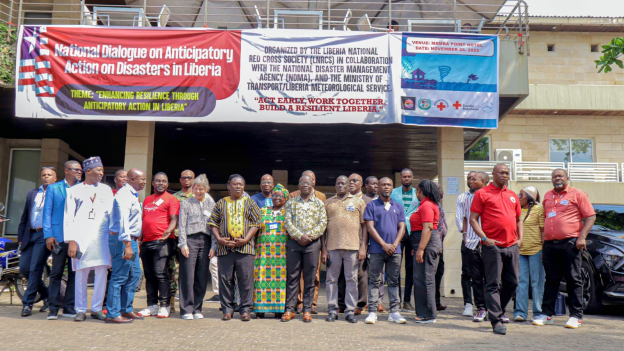
In a major step toward preventing avoidable loss and strengthening national preparedness, the Liberia National Red Cross Society, with support from the Swedish Red Cross, jointly convened a High-Level National Dialogue on Anticipatory Action on Disasters in Liberia along with key Government Ministries and agencies, including the National Disaster Management Agency and Liberia Meteorological Service (LMS).
Held under the theme “Enhancing Resilience through Anticipatory Action in Liberia,” the dialogue was also attended by the Environmental Protection Agency (EPA), Ministry of Agriculture, Ministry of Health, the National Public Health Institute of Liberia, Armed Forces of Liberia, UNICEF, Ecobank Liberia, and other humanitarian and technical partners.
The high-level National Dialogue aimed to strengthen national coordination, build shared ownership, and advance the development of a National Anticipatory Action Implementation Plan that will position Liberia to act before disasters strike—aligning the country with global best practices in disaster risk management.
A Shift Toward Proactive Disaster Management
Opening the dialogue, the Secretary General of the Liberia National Red Cross, Mr. Gregory T. Blamoh, emphasized that Liberia can no longer wait for disasters to strike before taking action. “Early warnings must lead to early actions. Acting before a hazard becomes a crisis is the heart of anticipatory action, and it is essential if we are to save lives and reduce suffering.”
Mr. Blamoh highlighted the outcomes of a recently completed Multi-Risk Feasibility Study, which identifies forecastable hazards, potential triggers, and the systems Liberia must strengthen to make anticipatory action a reality. The study, conducted with support from the Swedish Red Cross and IFRC, represents a major milestone in the country’s resilience agenda.
Mr. Blamoh also outlined priority areas including strengthening early warning systems, establishing pre-arranged financing, improving community preparedness, and enhancing inter-agency coordination. The Liberian Red Cross Secretary General also stressed that anticipatory action requires collaboration, saying: “Disasters do not respect institutional boundaries—neither should our response.”
Government Commitment to Implementation
Hon. Ansu Dorley, Executive Director of the NDMA, described the dialogue as “a defining moment for Liberia’s disaster preparedness agenda.” He underscored that Liberia cannot continue waiting for disasters to occur before responding. He emphasized that the outcomes of the dialogue must be respected, implemented, and integrated into national systems. He noted that the dialogue on Anticipatory Action directly support the government’s ARREST Agenda for improved governance and service delivery.
Supporting Local Capacity and Localization of Response
Ms. Karin Westerberg, Head of Policy and Thematic Support at the Swedish Red Cross, praised the progress Liberia has made in advancing anticipatory approaches. She highlighted ongoing global challenges—rising climate-related disasters and declining humanitarian funding—and reaffirmed the importance of local capacity, noting: “Anticipatory action works best when rooted in national systems and built for the people most at risk.” She reaffirmed her institution’s commitment to supporting Liberia’s preparedness efforts. “The future of effective disaster management is local. Liberia’s strong volunteer presence and growing anticipatory action work are key to building resilience.”
During her visit to Grand Cape Mount, where the Liberian Red Cross assisted families affected by a devastating fire, she was impressed with the power of local volunteer networks. “The speed, dedication, and trust shown by the volunteers reflect true preparedness. Liberia is fortunate to have such committed responders.” She praised the collaboration between the Liberia National Red Cross and the Liberia Meteorological Service, marked by the signing of a Memorandum of Understanding earlier this year—a major step toward enhancing national early warning capability.
How the Dialogue Outcomes Will Benefit Disaster-Prone Communities
The real impact of the dialogue will be felt most strongly by communities that face repeated disaster threats. Anticipatory action will significantly strengthen community safety by ensuring faster and more reliable early warning systems, allowing families enough time to move to safer areas and protect essential belongings. By releasing assistance before conditions worsen, the approach reduces both human suffering and financial loss, while improving preparedness at the community level through trained volunteers who can respond quickly and effectively.
Additionally, anticipatory action enhances protection for vulnerable groups such as women, children, the elderly, and people with disabilities, who often face greater risks during emergencies. It also helps reduce damage to homes, farms, and livelihoods, supporting faster recovery and greater long-term resilience. A more coordinated national system prevents duplication, ensures better use of resources, and strengthens Liberia’s overall disaster readiness.
A Unified Path Forward
The dialogue concluded with a united commitment to strengthen national systems, deepen collaboration, and ensure that no Liberian is left behind when hazards threaten. The Liberia National Red Cross and its partners reaffirmed that anticipatory action is no longer optional—it is essential for protecting communities, preserving development gains, and building a safer and more resilient Liberia.

Comments are closed.